Normal Speaking Pace: How Many Words Per Minute Is Ideal (and How to Find Yours)
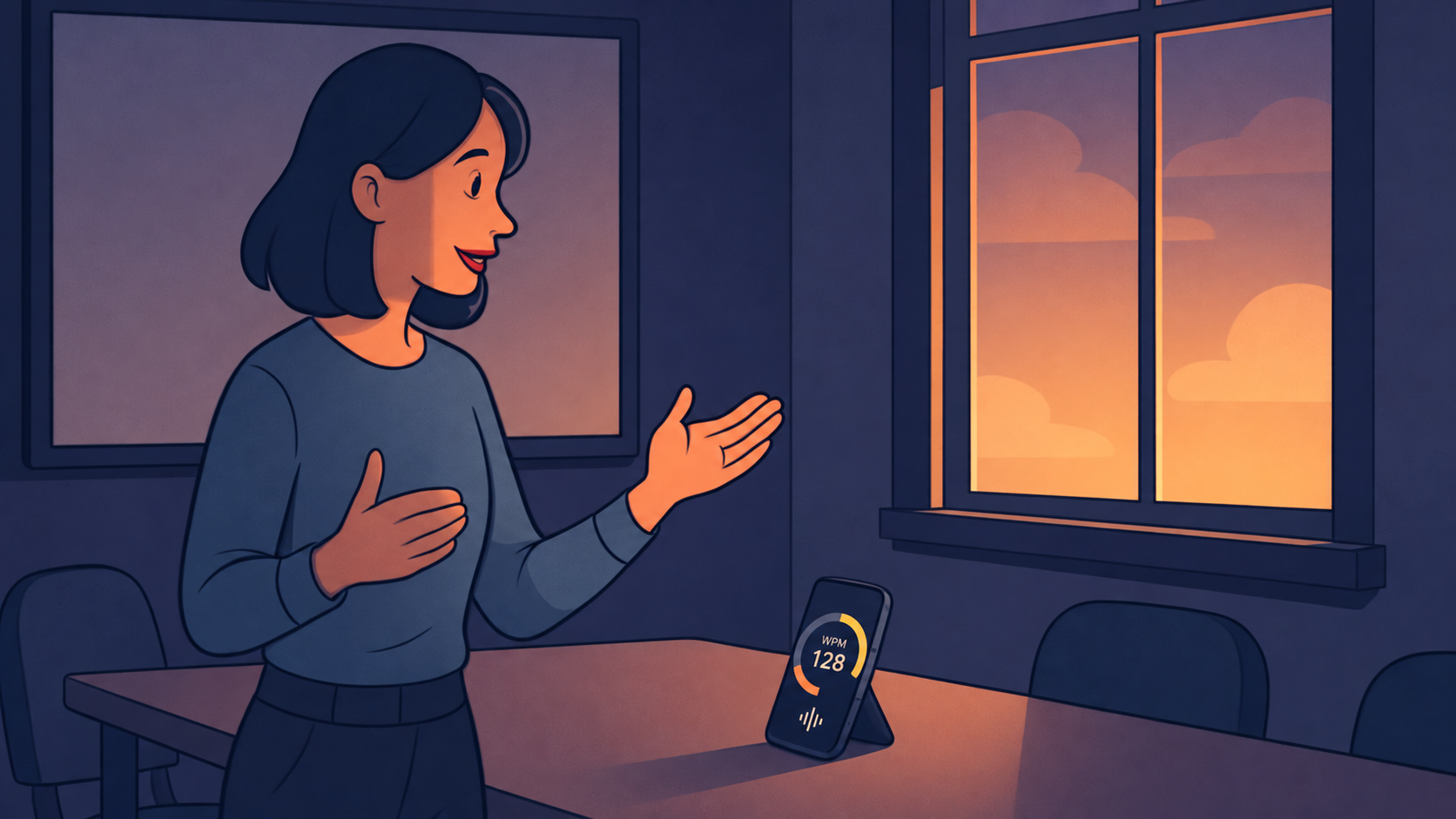
Someone tells you, kindly, that you "talk really fast." Or you watch a recording of your presentation and realize you raced through the whole thing in half the time you planned. Suddenly you're wondering what a normal speaking pace even is.
This guide gives you the usual ranges in words per minute, shows you how to measure your own speaking speed in about two minutes, and walks through practical ways to slow down (or speed up) without sounding robotic.
What is a normal speaking pace?
Speaking pace is how quickly you get words out, usually measured in words per minute (wpm). It's one of the first things a listener notices, even if they couldn't tell you why. Too fast and people struggle to keep up. Too slow and their attention drifts.
There's no single official number, and anyone who gives you one exact figure is oversimplifying. Pace depends on the language, the speaker, the setting, and even the topic. But there are ranges that most speech coaches and communication guides agree on, and they're a useful place to start.
Normal speaking pace in words per minute
Here are the rough ranges you'll see cited most often for English:
Under about 110 wpm: slow. Fine for emphasis or a very complex point, but over a whole talk it can feel heavy.
About 120 to 160 wpm: the comfortable middle. Most everyday conversation and most good presentations land somewhere in here.
Over about 170 wpm: fast. Easy to follow in an excited chat with a friend, harder to follow when you're explaining something new.
Treat these as guide rails, not rules. A speaker at 165 wpm with clear words and good pauses can be easier to follow than a speaker at 135 wpm who mumbles and never stops for breath. Clarity and pausing matter as much as the raw number.
What is a good speaking pace for a presentation?
For presentations, the usual advice is to sit toward the slower end of the conversational range, somewhere around 120 to 150 wpm. That's a little slower than you'd talk to a friend, for a few reasons:
Your audience is hearing it for the first time. You've rehearsed the material. They haven't. They need a moment to process each idea.
Rooms swallow sound. In a large space, or on a video call with a lag, fast speech blurs together.
Nerves speed you up. Almost everyone talks faster under pressure than they do in rehearsal, so aiming a little slow gives you a buffer.
A handy planning shortcut: at roughly 130 wpm, a 1,000-word script runs about seven to eight minutes. If your talk has to fit a strict time slot, cut words rather than planning to talk faster.
Natural speaking pace: why variety beats a perfect number
Here's the part most "ideal wpm" advice skips. Good speakers don't hold one steady speed. They speed up through details the audience can skim and slow down for the parts that matter: the main point, a key number, the ending.
A completely even pace, even a "perfect" one, tends to sound flat and rehearsed. What you want is a comfortable average with plenty of variation and real pauses. That's a big part of what makes great speakers sound relaxed, as we explain in why the best speakers sound like they're having a conversation.
So when you check your pace, look at two things: your average, and whether you ever change gears.
How to calculate your speaking rate (a quick speaking speed test)
You don't need special equipment to find your words per minute. A phone and a stopwatch are enough.
Pick a topic you can talk about easily. Something like "explain what you do at work" or "describe your favorite trip." Reading a script aloud will give you a different, usually faster, number than speaking off the cuff, so test both if you can.
Record exactly 60 seconds. Use your phone's voice memo app. Talk the way you normally would, not the way you think you should.
Count the words. Play it back and write down or transcribe what you said, then count. Many phones can generate a transcript, which makes this much faster.
That count is your wpm. If you recorded for a different length, divide the word count by the number of seconds and multiply by 60.
Do this three or four times on different days and topics. One recording can be thrown off by nerves or a topic you love. An average across several is your real baseline. If hearing your own voice is uncomfortable, that's normal, and our guide to recording and reviewing your speaking on your phone covers how to get past it.
If you'd rather skip the counting, Articulate records up to 60 seconds on your iPhone and gives you a pace score from 0 to 100 alongside scores for filler words and clarity, so you can track whether you're drifting fast or slow over time.
Signs you're speaking too fast
Your wpm number is useful, but your listeners give you clues too. You're probably going too fast if:
People ask you to repeat things, especially names, numbers, or the point you just made.
You run out of breath mid-sentence or finish sentences with a gasp.
Your words blur together on the recording, with word endings disappearing.
You finish early when you've timed your talk, sometimes by a lot.
Your filler words go up. When your mouth outruns your planning, ums and likes fill the gaps. We cover that link in detail in how to stop saying um and uh.
Fast talkers are often energetic, enthusiastic, and quick thinkers. Speed isn't a flaw in itself. It just becomes a problem when it costs you clarity.
How to slow down your speaking pace
"Just slow down" is easy to say and hard to do, because your natural speed feels normal to you. These techniques work better than willpower alone.
Pause instead of slowing every word. Dragging out each word sounds odd. Adding a short pause at the end of each sentence brings your average down and sounds far more natural.
Use shorter sentences. Long, chained sentences ("and then, so, and also") pull you forward. Short sentences with a clear stop give you built-in breaks.
Finish your consonants. Pronouncing the ends of words, like the t in "about" or the d in "planned," physically slows you down and makes you clearer at the same time.
Breathe at the full stops. Take a small breath at the end of each sentence. You can't rush while you're breathing.
Mark your notes. In a script or slide notes, add a small symbol where you want to pause or slow down. It's a simple visual cue when adrenaline kicks in.
Find one friendly face. Talking to a single person in the room, as if across a table, naturally brings you back to a conversational speed.
Speaking speed practice: 4 drills to try this week
These take a few minutes each. Do one or two a day and recheck your wpm at the end of the week.
The metronome read. Read a paragraph out loud at your normal speed, then read it again deliberately slower, with a pause at every comma and full stop. Record both and compare. Most people find the slower version sounds better than they expected.
The three-speed retell. Explain the same short story three times: fast, slow, and somewhere in between. It teaches you that pace is a dial you control, not a fixed trait.
The key-point slowdown. Record a 60-second answer to a question. Before you start, choose the one sentence that matters most, and say only that sentence noticeably slower. Listen back and check whether it stands out.
The timed talk. Take a one-minute topic and try to fill exactly 60 seconds with about 130 words of content. If you keep finishing early, you're rushing.
To turn drills like these into a habit, try folding them into a 5-minute daily speaking practice.
Is a slow speaking pace a problem?
Less often than fast speech, but it can be. If you're well under the usual range for a whole conversation, listeners may start finishing your sentences in their heads, or lose interest before you reach your point.
Slow speakers usually aren't speaking each word slowly. More often, the time goes to long gaps while they search for the next idea, or to repeating themselves. The fixes look a little different:
Lead with your point. Say the conclusion first, then add detail. It's easier to keep moving when you know where you're headed.
Prepare your first and last sentence. Most long hesitations happen at the start and end of what you say.
Cut the restating. Listen to a recording and notice how often you say the same idea twice. Saying it once, clearly, speeds you up without rushing.
Speaking pace in interviews, calls, and meetings
Different settings call for slightly different speeds.
Job interviews. Nerves push most people faster. Aim for a calm, middle-of-the-range pace and let yourself pause before answering. A short pause reads as thoughtful, not unprepared.
Phone and video calls. Without body language, and with audio that can cut out, slow down a little more than usual and leave clear gaps so the other person can jump in.
Meetings. When you finally get a chance to speak, it's tempting to rush before someone interrupts. Slowing down actually makes you sound more sure of yourself.
How long does it take to change your speaking speed?
Your natural pace is a long-standing habit, so expect it to take a few weeks of regular practice before a new speed feels normal. The first change is awareness: you'll start noticing when you're speeding up while it's happening, instead of only on the recording afterward.
Under pressure, old habits come back. That's expected. Keep measuring every so often and look at the trend over weeks rather than any single day.
The short version
Most comfortable English speech sits somewhere around 120 to 160 words per minute, with presentations toward the slower end.
Measure your own pace: record 60 seconds, count the words, and average a few tries.
To slow down, pause at the end of sentences, use shorter sentences, and finish your consonants.
Vary your speed on purpose, and slow down most for the point you want people to remember.
The right pace isn't a magic number. It's the speed at which your listener can follow every word, and that's something you can practice.