How to Record, Review, and Actually Improve Your Speaking Skills Using Your Phone
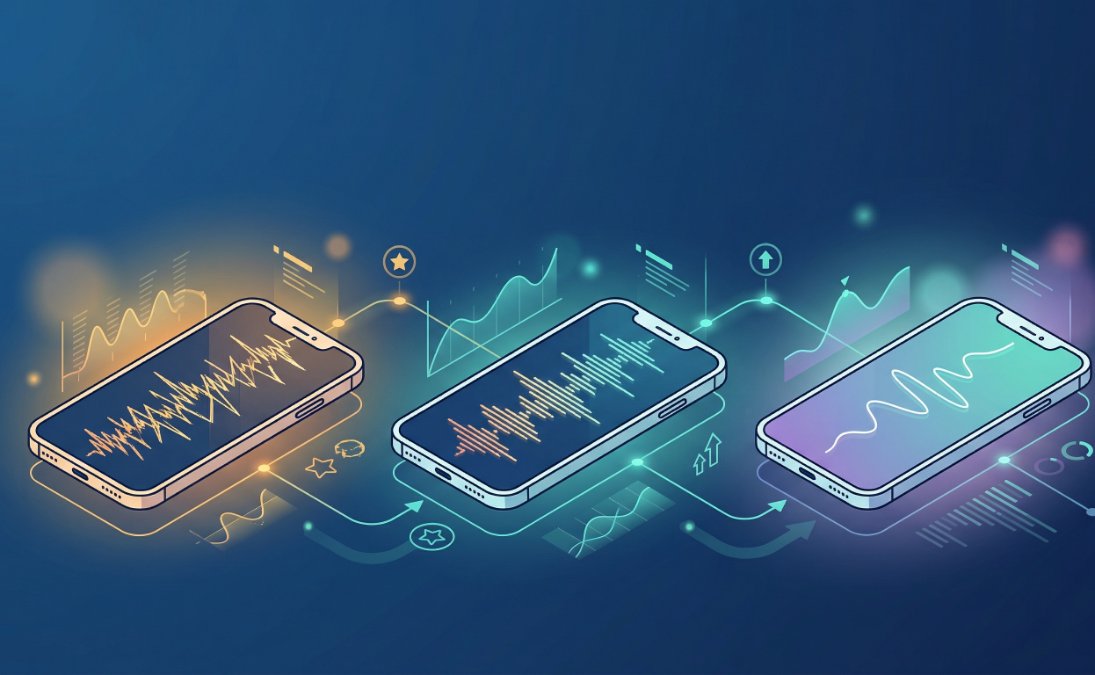
The gap between knowing you should practice speaking and actually doing it effectively is enormous, and your smartphone can close it. Research shows 82% of professionals believe they could improve their public speaking, yet only 11% actively seek training. Meanwhile, the speech coaching market hit $5.67 billion in 2024 and is projected to reach $9.77 billion by 2033, signaling massive demand for accessible speaking improvement tools. The device in your pocket, paired with the right techniques and increasingly powerful AI, can deliver the kind of deliberate practice that once required expensive coaches charging $100 to $500 per hour.
The Science Behind Recording Yourself (and Why Top Coaches Insist on It)
TJ Walker, CEO of Media Training Worldwide, puts it bluntly: "You must record your entire presentation on video and then watch it. It is the only way to find out if your presentation is any good." Carmine Gallo, Harvard instructor and author of Talk Like TED, echoes this in Harvard Business Review: record yourself practicing on your smartphone, play it back, make a list of the filler words you use most, write them down, and practice again. When you catch yourself about to use one, aim for silence instead.
The research backs them up. A Lincoln University study (Tailab & Marsh, 2020) found that students who video-recorded their presentations showed significantly increased awareness of delivery skills without provoking anxiety. They became more confident, better prepared, and less nervous. A separate study at Texas Tech (Fireman & Kose, 2003) demonstrated that participants who watched their own prior performance via video significantly outperformed those trained through modeling or extended practice alone. Video self-observation fostered what researchers called "a unique form of active observation" that accelerated skill transfer. Across 63 studies reviewed by Tripp & Rich (2012), video-based self-observation emerged as a consistently effective improvement method.
The deliberate practice framework pioneered by K. Anders Ericsson confirms that quality and intentionality of practice matter more than raw hours. Speaking improvement requires four elements: motivation, repetition, feedback, and tailored activities. Recording yourself on your phone checks all four boxes. You practice intentionally, review immediately, get feedback (from yourself or AI), and can target specific sub-skills each session. Helen Lie's doctoral research at the University of San Francisco identified 16 distinct deliberate practice activities used by elite professional speakers, many of which center on recording and reviewing delivery.
The Record-Review-Repeat Cycle That Actually Works
The most effective self-improvement method follows a three-step loop. First, record your full speech or practice segment without stopping. Communication coach Vinh Giang, whose speaking content has garnered over 15 million social media followers, insists you should never restart on mistakes. Recover and continue, because that mimics real conditions. His viral 21-day challenge prescribes recording one uninterrupted take daily, starting at one minute and building to 90 seconds, progressing from easy to difficult prompts.
Second, review with surgical focus. The biggest mistake speakers make is trying to fix everything at once. Coach Liam Sandford calls this the "circle of doom," where noticing every flaw simultaneously creates overwhelm and reinforces anxiety. Instead, watch your recording twice: once for overall impression, then again focusing on one specific element (filler words only, or pace only, or body language only). Gallo recommends a target speaking rate of 140 words per minute for virtual presentations, noting that anything above 170 WPM is too fast for audiences to absorb. You can measure this by sending your audio to a speech-to-text app and counting words per minute.
Third, repeat with one targeted improvement. Record again focusing on that specific fix. Compare to the previous recording. This focused iteration produces measurable gains far faster than vague "practice more" approaches.
For frequency, Gallo recommends rehearsing at least 10 times for any major presentation. For ongoing skill development, recording once every few days to once a week, combined with comparison against older recordings, builds a clear improvement trajectory. TED curator Chris Anderson advises practicing until the talk sounds natural, not rehearsed, noting that speakers pass through a valley where memorized content sounds stilted before emerging with both fluency and passion.
What to Evaluate in Your Recordings
When reviewing, target these specific dimensions across separate viewing sessions:
Filler words: Count every "um," "uh," "like," "you know," "so," and "basically." The goal is replacement with deliberate pauses, which actually sound more confident and authoritative to listeners.
Pace and pauses: Check for rushing (anxiety-driven) or dragging. Strategic pauses before key points create emphasis, while awkward gaps signal lost thoughts.
Vocal variety: Listen for monotone delivery. Vary pitch, volume, and speed. Slow down for critical points, speed up for energy.
Body language (video only): Watch for purposeful gestures versus distracting fidgeting, open posture versus closed, and whether facial expressions match emotional content.
Eye contact: Are you looking at notes, slides, or the camera/audience? This single factor dramatically affects audience connection.
Why You Cringe at Your Own Voice (and Why That's Actually a Good Sign)
Nearly everyone hates hearing their recorded voice. Psychologists Holzman and Rousey coined the term "voice confrontation" in 1966 to describe this phenomenon. The science is straightforward: when you speak, you hear your voice through both air conduction and bone conduction through your skull, which emphasizes lower frequencies and makes your voice sound deeper and richer to yourself. Recordings capture only air-conducted sound, the higher, thinner version that everyone else has always heard.
A striking 2013 study found that participants rated their own voice significantly higher when they didn't recognize it as theirs. This proves the negative reaction isn't about sound quality but about self-evaluation and identity disruption. Only 38% of people can even identify their own recorded voice within five seconds.
The good news: repeated exposure desensitizes the discomfort. Dr. Aziz Gazipura of the Social Confidence Center reports that he committed to recording video after video, audio after audio, until it became just another part of life. Over time, he stopped disliking his voice, not because it changed, but because he changed how he perceived it. Starting with audio-only recordings before graduating to video can ease the transition. The cringe itself signals self-awareness, the very trait that drives improvement.
How AI Turns Subjective Impressions Into Objective Data
The most transformative shift in speech practice is AI-powered analysis that replaces guesswork with metrics. Where manual self-review is subjective, mood-dependent, and prone to negativity bias, AI tools provide consistent, granular, instant feedback across every session.
Modern AI speech coaching apps track filler word counts with exact placement mapping, words-per-minute benchmarked against TED speakers, pitch contour and vocal variety, eye contact percentage, body language patterns, hedging language ("I think," "maybe," "sort of"), and progress trends over weeks and months. A 2024 Taylor & Francis study found students perceived AI feedback as more neutral and unbiased than peer feedback, while a 2023 SAGE Journals study documented significant pre/post speaking score improvements among participants using AI evaluation programs.
The leading apps each serve different needs. Yoodli, endorsed by Toastmasters International and used by over 300,000 professionals, functions as "Grammarly for speech," analyzing recordings and providing real-time coaching during video calls. Orai takes a mobile-first approach with gamified lessons and a confidence scoring system, acting as a fitness tracker for your speaking voice. Poised specializes in invisible real-time feedback during Zoom and Teams meetings, tracking empathy and tone alongside standard metrics. Speeko offers structured curricula with vocal warm-ups and exercises from voice coach Roger Love. These tools range from free tiers to roughly $10 to $25 per month, a fraction of even a single session with a human coach.
The key advantage isn't just cost. AI detects subtle rhythmic patterns and micro-habits that speakers aren't even aware of. It evaluates 100% of practice sessions uniformly, and it tracks longitudinal progress, transforming "become a better speaker" from a vague aspiration into a measurable, data-driven journey. Research suggests the most effective approach combines AI feedback with occasional human coaching, using technology for daily practice and a human eye for strategic, contextual guidance.
Setting Up Your Phone for the Best Possible Recordings
Proper setup takes two minutes and dramatically improves recording quality. Position your phone at eye level using a tripod. A Joby GorillaPod works well for desks, while a full-standing 62" tripod suits presentation practice. Record in landscape mode always, as it fills screens naturally and looks professional. Ensure your primary light source is in front of you, not behind. Facing a window provides excellent natural lighting. Frame yourself from the waist up to capture gestures and upper body language.
Enable Do Not Disturb before every recording session. On iPhone, set Voice Memos audio quality to "Lossless" in Settings. For video, 1080p at 30fps strikes the right balance of quality and file size. If audio quality matters most and you're willing to invest, a Rode VideoMic Me (roughly $60 to $80) plugs directly into your phone and captures dramatically cleaner sound than the built-in microphone.
For quick practice sessions focused on vocal delivery, audio-only recording through Voice Memos or Google Recorder works well. The files are smaller, the setup simpler, and the iteration faster. For comprehensive review that includes body language, eye contact, and physical presence, video is essential. Many AI analysis tools require video to deliver their full feature set. Do a 10-second test recording before each session to verify audio levels, lighting, and framing.
Your Next Step
The professionals who improve fastest aren't those with natural talent. They're the ones who close the feedback loop. Recording yourself on your phone creates the feedback that transforms vague practice into deliberate improvement. The voice confrontation discomfort fades within days of consistent exposure. The research is clear: focused, recorded practice with structured review produces measurable gains in confidence, clarity, and delivery that compound over time. AI tools have made this process faster, more objective, and radically more accessible, delivering coaching-quality analysis for the cost of a monthly coffee. Your phone is already in your pocket. The only remaining step is pressing record.